Genre
Synopsis
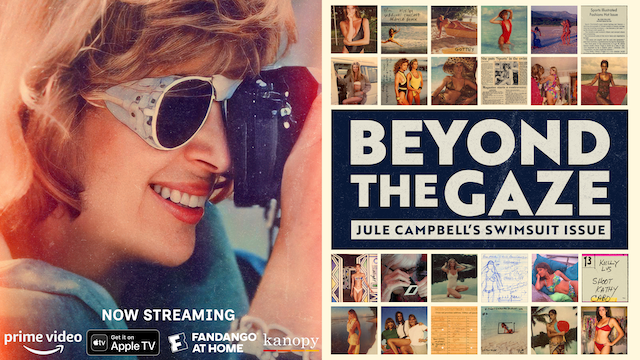
Set against the sweeping cultural upheaval of the 1960s through the 1990s, BEYOND THE GAZE tells the story of Jule Campbell, the visionary editor who transformed Sports Illustrated’s failing winter issue into the Swimsuit Issue — a phenomenon that would reshape beauty, commerce, and the national conversation about women’s bodies. When Jule arrives at the magazine in the early 1960s, she enters a smoke-filled “Mad Men” newsroom built by and for men, where women are secretaries, not decision-makers, and power is performed nightly at Ho Ho’s restaurant, where male editors drink, trade stories, and place bets on how many subscribers will cancel over the magazine’s controversial new direction. Observant and strategic, Jule learns to navigate the sexism rather than confront it head-on. Given a last-ditch assignment by managing editor Andre Laguerre — “go somewhere warm and put a beautiful woman on the cover” — she quietly reframes the project on her own terms. Influenced by the changing role of women in society and the emerging ideas of The Feminine Mystique, she casts athletic, healthy models and insists they be photographed with dignity, individuality, and agency rather than as pinups. The issue becomes an unexpected sensation, rescuing the magazine financially while trapping Jule in a paradox: she has created something powerful without gaining real authority over it.
As Jule grows the annual Swimsuit Issue into a cultural juggernaut, she becomes both champion and protector of the women she works with, fighting predatory sponsors, pushing for diversity, and mentoring models inside an institution that refuses to promote or pay her equally. The newsroom’s hostility persists even as profits soar, reinforcing that her success benefits everyone except herself. At home, the cost of her ambition is borne by her daughter Paige, who grows up feeling abandoned and later challenges her mother’s work through the lens of second-wave feminism and the expanding expectations placed on working women.
Jule’s mentorship of thoughtful model Helen Ross introduces an ideological challenge she cannot control, while her collaboration with Cheryl Tiegs produces images that blur the line between empowerment and objectification. When Andre retires, Jule loses her only ally and is left exposed to corporate leadership that profits from her work while denying her equality. A humiliating refusal of a raise — justified by the assumption that she has a husband to support her — forces her to confront how deeply the system resists change. She stays anyway, believing that her presence is the only protection the women around her have. Driven by the growing sexual freedom reflected in media and in cultures beyond the United States — particularly in Brazil — Jule makes the daring decision to submit a photograph of Cheryl Tiegs in a white fishnet suit with her nipple visible, a direct challenge to the men who control publication. In 1978, the image ignites national controversy, propelling the Swimsuit Issue to unprecedented success while fueling protests and a cultural battle over ownership of the female body. What was intended as a test of boundaries becomes a flashpoint in a broader conversation about liberation versus exploitation. The photograph takes on a life beyond Jule’s control, placing her at the center of debates about representation, sexuality, and agency. She finds herself on talk shows arguing with feminists, defending her belief that women can claim power over their own image even within a commercial system. The controversy spills into every aspect of her life — in protest marches outside the magazine, in the newsroom where male colleagues profit from the uproar, and at home as Paige and Helen confront her from opposing generational perspectives about what the images mean and the damage they may cause to women in a growing feminist society.
In the film’s final chapter, Jule reckons with the legacy of a career shaped by both triumph and compromise. Many of the women she championed have become cultural icons and entrepreneurs, evidence of the opportunities she helped create even as debates about objectification persist. Her tenure culminates in a milestone long denied— the first Black model on the cover — symbolizing progress achieved through persistence rather than approval and underscoring how incomplete the work of change remains.
In the film’s epilogue, as Jule prepares to retire, she confronts the unresolved contradictions of her life: the daughter she struggled to reach, the marriage strained by decades of imbalance, and the realization that the images she crafted have traveled far beyond her control. Yet in meeting her successor, MJ Day, a younger woman who moves through the industry with a confidence that Jule never had the freedom to claim, she finally recognizes the impact of her life’s work. MJ represents a generation that can stand openly in the space Jule had to carve out in the shadows, and for the first time, Jule understands that the cost of her sacrifices was not only loss, but possibility for the women who came after her.
Beyond the Gaze is a portrait of a woman who learned to navigate a flawed system to create change from within — a story of ambition, motherhood, and feminism that illuminates the complicated paths women take to claim authorship, independence, and power in a world that resists them, and the personal cost of doing so.
Bio
Jill is a documentary Director, Producer, and Editor who strives to capture authentic moments of humanity that highlight our shared experience. Jill began her career in the theater, writing and producing plays at La Mama, the Dublin Fringe, the Public Theater, and as a resident artist at Mabou Mines. She pivoted to documentary with the 2010 documentary "Dancing Across Borders" (Netflix, Apple TV.). Following the success of that feature, Jill has produced many feature documentaries that have screened at major festivals including Tribeca, DOC NYC, Atlanta, Art Fifa, Hamptons, Montclair, Miami, Seattle, Woodstock, and Warsaw. Jill was a producer for the documentary, "Never Too Late: The Doc Severinson Story" (Dirs. Kevin Bright, Jeff Consiglio, PBS American Masters, 2020). Jill has written and directed three feature-length documentaries including the award-winning "Mr. Chibbs" (Peacock, Kanopy, Amazon), a 2017 Village Voice Critic’s Pick, "Mr. Chibbs" traces the rise and fall of NBA legend Kenny Anderson, and "Seat 20D" (Amazon, Kanopy, Apple TV) a meditation on the healing power of self-expression that follows artist Suse Lowenstein’s journey to overcome her grief following the murder of her son. Jill received her MFA from Hunter College, where she studied documentary filmmaking. Jill's most personal documentary, "Beyond the Gaze: Jule Campbell's Swimsuit Issue," premiered at Woodstock Film Festival in October 2024 and screened at DOC NYC and 22 festivals around the country. It premiered theatrically at NYC's IFC Center. The film examines Jule's trailblazing life and career from a feminist perspective.
Awards History
Best Documentary - Omaha Film Festival, 2024
Best Sports Film - Centre Film Festival, 2025
Best Documentary - Black Bear Film Festival, 2025
Audience Award - Hells Half Mile Film Festival, 2025
Enlightenment Award - Utah Doc Fest, 2025