Genre
Synopsis
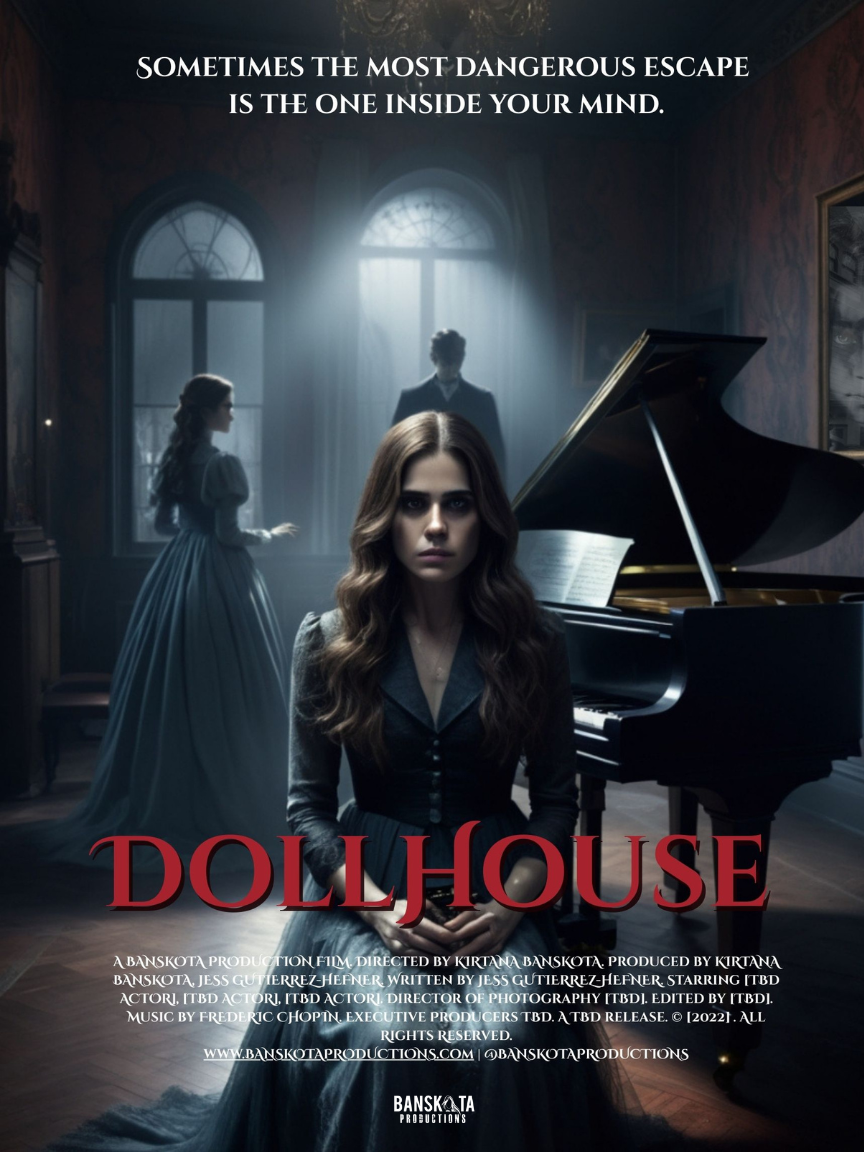
Jamie Paredes is a gifted but deeply fractured pianist living on the brink of self-destruction. Haunted by drowning nightmares and shadowy visions of a Little Girl and a Teenager, Jamie numbs her pain with vodka and pills. She cannot bring herself to play Chopin’s Nocturne in C Sharp Minor—the final piece her father loved—her hands freezing each time she tries.
At an art gallery gala, Jamie meets Michael, a charismatic and unsettling stranger who effortlessly completes the Nocturne when she cannot. Fascinated by broken things in need of “restoration,” Michael pays off Jamie’s debts—and then abducts her.
Jamie awakens inside a surreal, life-sized Victorian dollhouse. Though pristine from afar, the house rots up close. Dressed like a porcelain doll and forced into rigid obedience, she is subjected to psychological torment. Michael demands perfection. Disobedience brings brutal punishment—not only to Jamie, but to the other “captives”: a terrified Teenager and a haunting Little Girl.
As the nightmare intensifies—with water torture, looping hallways, and impossible architecture—Jamie realizes the dollhouse defies the laws of reality. In a desperate bid for survival, she confronts Michael, turning his violence against him. When she kills him, the world fractures and dissolves.
Jamie awakens again—this time in a psychiatric treatment facility. The Dollhouse was never real. For fifteen years, Jamie has been catatonic, trapped in dissociative psychosis after a devastating trauma at eighteen. Michael is a neurologist overseeing an experimental regressive therapy simulation. Mandy, Jamie’s closest ally, has been guiding the procedure.
The truth emerges: Jamie’s father was terminally ill, and in a desperate act of love, teenage Jamie gave him the pills that ended his life. Unable to forgive herself, her mind splintered into fragments—the Little Girl and the Teenager—locking her inside a mental prison.
Offered a final choice—retreat into oblivion or confront the memory—Jamie chooses to live. She re-enters her fractured mind one last time, embraces her younger selves, and integrates her shattered identity.
In the hospital day room, Jamie sits at a piano and finally plays Chopin’s Nocturne flawlessly. The melody is whole at last. Yet as reality subtly blurs and the Teenager’s wounded wrists linger in view, it’s clear: healing is not erasure. Survival means carrying the scars—and choosing to play anyway.
Bio
Kirtana Banskota is an award-winning Nepali-American Producer, Director, and Actor whose Production Company, Banskota Productions, has offices in Austin, TX and Kathmandu, Nepal. She Chairs the Board of Women in Film and Television and is the co-founder of Nepal America Film Society and the Nepal America International Film Festival. She is the Founder and CEO of Banskota Productions which produces narratives and documentaries of unheard stories from across the globe. Kirtana is also the co-founder of the South Asian House which has partnered with festivals like SXSW, Tribeca and Art Basel. Her first SAG film she co-directed, Premonition, released in October 2023, while Where the Stars Are, a feature length Asian musical, she co-directed and produced is set to premiere December 2023. Banskota also has several shorts set to compete in the film festival circuit in 2023. Her recent climb to Everest Base Camp reignited her childhood passion for the region and brought awareness to the social impact of climate change, leading to her new animation that won the International Development Award at the WIFTI script pitch challenge- Maya from the Himalaya and her docuseries, Planet Possible. She is also working on a feature documentary focusing on the issues of the Texas/Mexico Border called Crossing the Rio Grande.